WATCH: Blood-Red Skies Shock Western Australia As Cyclone Narelle Triggers Massive Dust Storms
· Free Press Journal
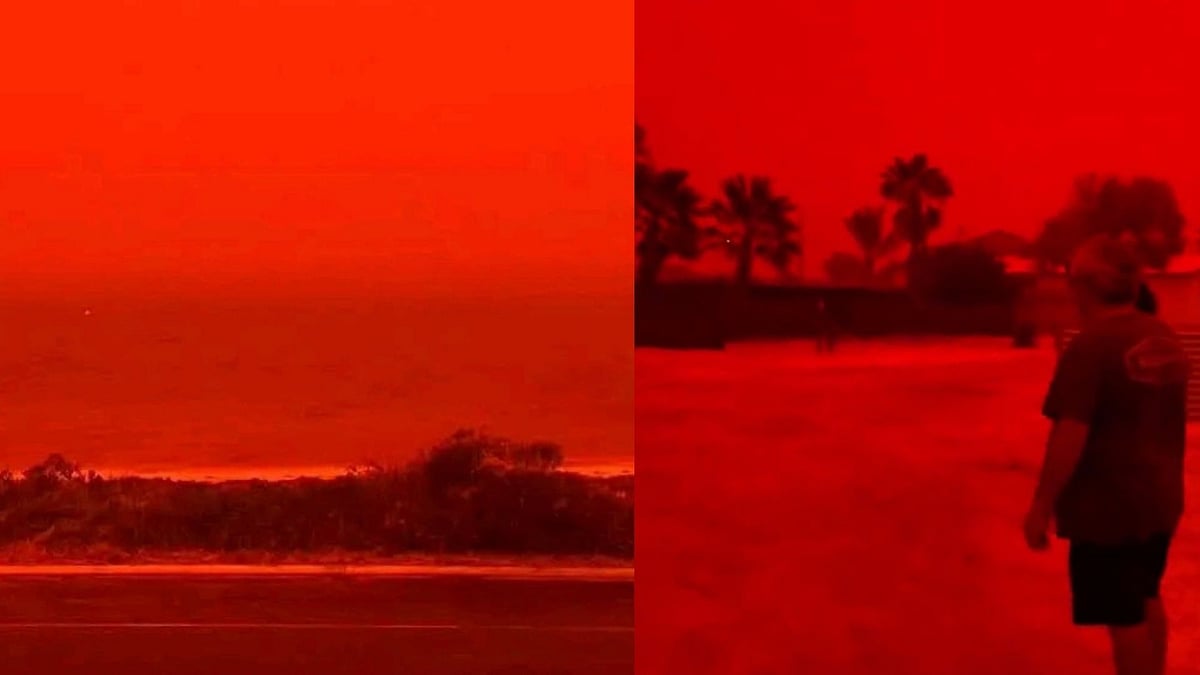
Residents across parts of Western Australia witnessed an extraordinary natural phenomenon when the sky suddenly turned a deep crimson red. The dramatic transformation was most visible in Shark Bay and Denham, where powerful dust storms linked to Tropical Cyclone Narelle blanketed entire towns in thick red haze.
Visit playerbros.org for more information.
Within minutes, daylight appeared to vanish as dense dust clouds reduced visibility to near zero, leaving streets dim and the air heavy with fine particles.
NO, that's not a filter! ☁️ The sky turned an eerie shade of red in Western Australia as dust filled the air ahead of Tropical Cyclone Narelle. pic.twitter.com/dCQ2hjFluI
— AccuWeather (@accuweather) March 28, 2026
Why did the sky turn red?
The unusual colour was not artificial or edited imagery but the result of atmospheric science. Cyclone-strength winds lifted vast quantities of iron-rich desert soil into the atmosphere. These tiny dust particles scattered shorter blue light wavelengths while allowing longer red wavelengths to dominate, creating the striking blood-red glow.
Western Australia’s interior contains highly oxidised soils rich in iron minerals, which intensify the red colouring when suspended in the air during large-scale dust events.
Apocalyptic orange skies engulf Shark Bay, Western Australia as Tropical Cyclone Narelle closes in turning day into a haunting orange haze pic.twitter.com/LkOjh8YSGi
— Surajit (@surajit_ghosh2) March 28, 2026
Social media debate: Real or edited?
Videos of the phenomenon quickly went viral online, sparking debate among viewers. Some users questioned whether filters or colour enhancement were used due to the surreal appearance of the sky. In response, many residents shared unedited clips labelled “no filter,” confirming the scenes were genuine and experienced across multiple communities.
Meteorologists noted that similar red-sky events have occurred during severe dust storms worldwide, though they remain rare and visually striking.
Apocalyptic red skies over Shark Bay, Western Australia, as Tropical Cyclone Narelle approaches.
— Eric Unfiltered™ (@erictrumpfan1) March 27, 2026
A massive dust storm has turned daylight into a deep red haze, with outback dust whipped up by the cyclone’s powerful winds.
Raw footage from a local resident - no edits.
Video… pic.twitter.com/8012WF8Eyq
Regions impacted across western Australia
While the Gascoyne region experienced the most dramatic conditions, the broader storm system affected several coastal areas. Towns along the Pilbara coast, including Exmouth and Karratha, faced strong winds, blowing dust, and deteriorating air quality as the cyclone moved through the region.
Emergency services urged residents to remain indoors, particularly those with respiratory conditions, as airborne dust levels surged.
skies over western australia turned an eerie blood red as a powerful tropical storm swept in, kicking up massive amounts of dust across the region. no filter on these images/video pic.twitter.com/jZX1P5ht7D
— moon, the Creator (@alilmoonn) March 28, 2026
Cyclone Narelle’s rare “triple-strike” path
Cyclone Narelle has drawn attention from weather experts due to its unusually long and complex journey across Australia. The system initially made landfall over Queensland’s Cape York Peninsula on March 20 before travelling west through the Northern Territory. After re-strengthening over warm Indian Ocean waters, it struck Western Australia with renewed intensity.
At its peak, the cyclone reached Category 4 strength, producing wind gusts exceeding 200 km/h. Reports from coastal communities described structural damage, including roofs torn from buildings in Exmouth and Coral Bay.